Zahrtmann’s School
A New School of Painting, 1885–1908
.jpg)
Kristian Zahrtmann: Once Upon a Time There Was a King and a Queen. 1887. The Hirschsprung Collection.
Kristian Zahrtmann (1843–1917) occupies a central place in Danish art history as a history painter, a leading figure in the Nordic artists’ community in the Italian mountain town of Cività d’Antino, and a teacher at the Artists’ Independent Study Schools for more than two decades.
The museum’s founder, Heinrich Hirschsprung, was one of Zahrtmann’s most important supporters. In 1875, he acquired his first work by the artist, a portrait of the model Madam Ullebølle. More works followed, and during Zahrtmann’s lifetime the collection became the largest publicly accessible display of his art. While the Danish Golden Age represented the artistic tradition of the early 19th century, Zahrtmann’s paintings were fresh, provocative contemporary art to the museum’s founder.
Today, The Hirschsprung Collection holds a substantial collection of Zahrtmann’s work. It includes paintings, drawings and sculptures, as well as the artist’s palette, brushes and furniture from his home, together with correspondence between Zahrtmann and his family, friends and fellow artists. The collection also contains several works by his students.
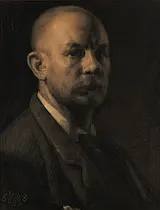
Kristian Zahrtmann: Self-Portrait. 1888. Zahrtmann produced numerous self-portraits throughout his life. Executed in charcoal and chalk, this work is considerably more subdued than his painted self-portraits. Its strong contrasts of light and shade recall the self-portraits of the Dutch Baroque painter Rembrandt van Rijn, one of Zahrtmann’s great artistic role models.
The Artists’ Independent Study Schools
Rebellion was in the air in 1870s Europe. Impressionism and Naturalism had recently emerged in France, and the idea that modern artists should reflect their own time and experiment with new subjects and forms of expression had also reached Denmark. It found support among the younger generation, but not among the professors at the tradition-bound Royal Danish Academy of Fine Arts. In protest against the Academy’s outdated approach to artistic education, a group of Danish artists founded the Artists’ Independent Study Schools in 1882.
Laurits Tuxen became the schools’ first director, P.S. Krøyer their first teacher, and three years later Zahrtmann also joined the teaching staff. He quickly became so popular that the school became commonly known as “Zahrtmann’s School”. Students were encouraged to experiment with daring colours and striking colour contrasts, and great emphasis was placed on helping young artists develop their own distinctive style of painting.
Zahrtmann favoured exclusively male artistic circles. It was widely known that he disapproved of women painters and that female students were not welcome in his classes. The generations of Danish and Nordic artists who studied at Zahrtmann’s School were therefore all men

Fritz Syberg: Spring. 1891–93. The Hirschsprung Collection.
Zahrtmann taught more than 200 students, including several of the artists now known as the Funen Painters, such as Fritz Syberg, Johannes Larsen and Peter Hansen, all of whom are represented in the museum’s collection
Zahrtmann taught more than 200 students, including several of the artists now known as the Funen Painters, such as Fritz Syberg, Johannes Larsen and Peter Hansen, all of whom are represented in the museum’s collection
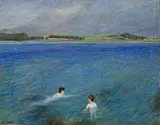
Johannes Larsen: Boys Bathing. 1889. As the Royal Danish Academy of Fine Arts was unwilling to exhibit works by students from Zahrtmann’s School, Zahrtmann organised an exhibition for them himself in 1891. Among the works Johannes Larsen showed was this painting, whose loose brushwork clearly reflects the influence of French Impressionism and marks a departure from the academic tradition.
Colourful Italian Scenes
Zahrtmann had a deep love of Italian art and travelled to Italy many times. In 1883, he visited the small mountain town of Cività d’Antino, east of Rome, for the first time. From then until 1913, he spent almost every summer there, often joined by friends, colleagues and students. The local residents grew so fond of Zahrtmann that in 1902 they made him the town’s first honorary citizen.
Zahrtmann painted numerous scenes from the town, filled with the light and colours of southern Europe. Towards the end of his life, when he had a villa built in the Fuglebakken district of Frederiksberg, he named it Cività d’Antino in memory of the small town high in the Abruzzo mountains.
Zahrtmann painted numerous scenes from the town, filled with the light and colours of southern Europe. Towards the end of his life, when he had a villa built in the Fuglebakken district of Frederiksberg, he named it Cività d’Antino in memory of the small town high in the Abruzzo mountains.
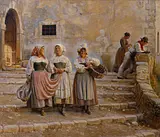
Kristian Zahrtmann: Girls Carrying Lime. Cività d’Antino. 1883. The Hirschsprung Collection.
The three smiling women are walking down the steps from the town gate of Cività d’Antino. This was Zahrtmann’s very first painting of the Italian mountain town that would later become his second home.
The three smiling women are walking down the steps from the town gate of Cività d’Antino. This was Zahrtmann’s very first painting of the Italian mountain town that would later become his second home.
Reinventing History Painting
Zahrtmann is now regarded as one of the great innovators of history painting. Over time, the colours in his work became increasingly bold and experimental, while his approach to historical subjects grew more personal.
He is particularly known for his paintings of Leonora Christina, daughter of King Christian IV, who spent 22 years imprisoned in the Blue Tower, accused of complicity in the treason committed by her husband, Corfitz Ulfeldt. Over the course of his career, Zahrtmann produced around 20 paintings of the king’s daughter, inspired by her autobiography Jammers Minde. Several of these can now be seen at The Hirschsprung Collection.
In his history paintings, Zahrtmann depicted a number of remarkable women from history and literature whom he believed had been treated unjustly. Alongside Leonora Christina, he painted several scenes featuring Queen Caroline Matilda and her love affair with J.F. Struensee, which ultimately led to the royal physician’s execution and the queen’s exile. In addition to these historical female figures, Zahrtmann was particularly drawn to subjects from classical mythology.
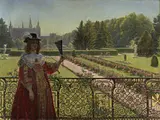
Kristian Zahrtmann: Leonora Christina in the Garden of Frederiksborg Castle. 1887. The Hirschsprung Collection.
The rose garden is bathed in sunlight, while the elegantly dressed Leonora Christina cools herself in the shade. Paintings of the king’s daughter became a hallmark of Zahrtmann’s work.
The rose garden is bathed in sunlight, while the elegantly dressed Leonora Christina cools herself in the shade. Paintings of the king’s daughter became a hallmark of Zahrtmann’s work.
A Celebration of Difference
As a painter, Zahrtmann was a true individualist. His interest in unconventional historical subjects and bold colours set him apart from the art of his time. Many of his works reveal a fascination with historical figures who challenged established gender roles and social norms. Some of his paintings explore homosexual themes, while others turn traditional gender roles on their head.
Zahrtmann often painted models who did not conform to conventional ideals of beauty, but instead possessed great character and expressive power. This aspect of his work, which celebrates difference and the unconventional, has only received greater attention in recent years, including in our previous special exhibition Kristian Zahrtmann – Queer Art and Passion.
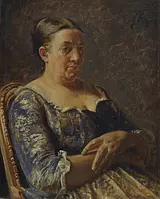
Kristian Zahrtmann: The Model Madam Ullebølle. 1874. Madam Ullebølle was Zahrtmann’s favourite model. Her large build and somewhat masculine appearance challenged contemporary ideals of beauty. Zahrtmann painted her on numerous occasions, and she gradually became a well-known figure in Danish art circles.
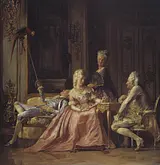
Kristian Zahrtmann: Scene from the Court of Christian VII. 1873. The Hirschsprung Collection.
Queen Caroline Matilda plays chess with her secret lover, the physician Struensee. In the background, her unsuspecting husband, Christian VII, lies teasing a parrot with his sword. Painted just over a century after Struensee’s execution and the queen’s exile, the work was a controversial choice of subject for the young Zahrtmann. Some of Caroline Matilda’s grandchildren were still alive at the time, and the royal court therefore attempted to buy the painting to prevent it from being exhibited. Instead, Zahrtmann chose to show it to the public at Charlottenborg.
Queen Caroline Matilda plays chess with her secret lover, the physician Struensee. In the background, her unsuspecting husband, Christian VII, lies teasing a parrot with his sword. Painted just over a century after Struensee’s execution and the queen’s exile, the work was a controversial choice of subject for the young Zahrtmann. Some of Caroline Matilda’s grandchildren were still alive at the time, and the royal court therefore attempted to buy the painting to prevent it from being exhibited. Instead, Zahrtmann chose to show it to the public at Charlottenborg.
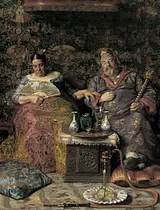
Kristian Zahrtmann: Once Upon a Time There Was a King and a Queen. 1887. The Hirschsprung Collection.
Is it history or fairy tale? Zahrtmann playfully questions the exalted status of monarchs in society.
Is it history or fairy tale? Zahrtmann playfully questions the exalted status of monarchs in society.