Vilhelm Hammershøi
Master of Silence
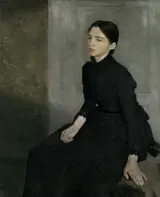
Hammershøi’s controversial debut work originally hung in the artist’s childhood home on Frederiksberg Allé. In 1896, Heinrich Hirschsprung succeeded in acquiring the painting from the family.
Vilhelm Hammershøi: Portrait of a young woman. The artist's sister Anna Hammershøi, 1885. The Hirschsprung Collection.
Vilhelm Hammershøi: Portrait of a young woman. The artist's sister Anna Hammershøi, 1885. The Hirschsprung Collection.
The Hirschsprung Collection is home to one of the world’s largest collections of works by Vilhelm Hammershøi. It includes paintings and drawings, as well as letters, photographs, exercise books and scrapbooks, together with the artist’s palette and furniture from his home.
Most of the collection originated in the private art collection assembled by the museum’s founders, tobacco manufacturer Heinrich Hirschsprung and his wife, Pauline. Further works, furniture and archival material were later donated to the museum by the Hammershøi family.
The collection includes works from the three central categories of Hammershøi’s art: interiors, landscapes and portraits. Most are painted in his distinctive, subdued and almost monochromatic palette of whites, blacks, greys and browns.
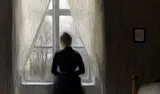
Vilhelm Hammershøi: Bedroom, 1890. The Hirschsprung Collection.
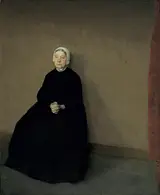
An Old Woman was the first work by Hammershøi that Heinrich Hirschsprung acquired for his collection. He purchased it directly from the artist in 1888.
Vilhelm Hammershøi: An Old Woman, 1886.
Vilhelm Hammershøi: An Old Woman, 1886.
The Quiet Sister Who Caused a Stir in Danish Art
The museum’s Hammershøi collection is particularly rich in major works from the artist’s early career. At its heart is his debut painting, Portrait of a Young Girl from 1885, depicting his younger sister Anna Hammershøi absorbed in her own thoughts.
With this work, the 21-year-old Hammershøi hoped to win the Neuhausen Prize at the Royal Danish Academy of Fine Arts exhibition. That year’s assignment was: “Portrait of a lady. Knee-length, life-size.”
Hammershøi entered the Royal Danish Academy of Fine Arts in 1879 at the age of 15. From 1883, he also studied under P.S. Krøyer at the Artists’ Independent Study Schools. This was the first time he exhibited one of his works at Charlottenborg, and the portrait would prove highly significant—not only for Hammershøi’s own career, but for Danish art more broadly.
When it became clear that the Academy’s exhibition committee did not consider the unconventional portrait worthy of the prize, it caused an uproar among Hammershøi’s fellow artists. In protest at the failure to recognise his talent, they launched a petition that became the starting point for a wider rebellion against the jury system at the Academy’s annual exhibition. This movement would later lead to the establishment of Den Frie Exhibition in 1891.
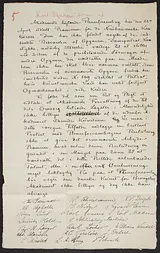
Outraged by the rejection of Hammershøi’s debut painting, Emil Hannover, who would later become the museum’s first director, drafted a letter of protest. The final version, however, was written by the art critic and future museum director Karl Madsen. The protest was signed by 41 artists, including P.S. Krøyer, Theodor Philipsen, L.A. Ring and Bertha Wegmann.
The Hirschsprung Collection’s letter archive.
The Painter of Quiet Rooms
Today, Hammershøi is best known for his paintings of sparsely furnished interiors, which earned him the nickname ‘the painter of quiet rooms’. He lived at seven different addresses in Copenhagen during his lifetime, and these homes served not only as private residences and studios, but also as his principal subjects.
Hammershøi’s interiors are usually empty or occupied by a single figure absorbed in reading or an everyday task. The artist himself, who was generally a man of few words, once said:
I have always thought there was such beauty in a room like that, even when there were no people in it—perhaps especially when there were none.
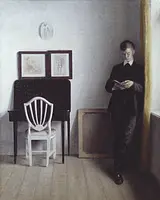
Vilhelm’s brother, the artist Svend Hammershøi, stands reading by the window in Hammershøi’s apartment. The painting was made while Vilhelm Hammershøi and his wife, Ida, were renting a flat in a newly built property on Aaboulevarden. The couple preferred older houses with a sense of history and patina, and after about a year they moved to Strandgade 30 in Christianshavn, where Hammershøi painted some of his best-known interiors.
Vilhelm hammershøi: Interior with a Young Man Reading, 1898. The Hirschsprung Collection.
The interiors are often carefully composed and clearly staged, with furniture, doors and windows arranged in seemingly endless variations and combinations. The strict geometry of these elements is softened by Hammershøi’s subtly blurred, almost hazy painting technique.