The Symbolists
Joakim Skovgaard: Christ leading the thief to Paradise. Luke 23,43, 1890. The Hirschsprung Collection.
Symbolism is a broad cultural movement that emerged across Europe in the late 19th century. The Hirschsprung Collection holds several major Danish works from the period. Artists such as Johan Rohde, Ejnar Nielsen, Vilhelm Hammershøi and the artist couple Agnes and Harald Slott-Møller embraced Symbolism, which can be seen as a response to modernity and the rapid growth of industrial society.
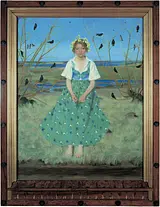
Harald Slott-Møller: Spring, 1896. The Hirschsprung Collection.
The Symbolists’ sensuous, poetic visual language and allegorical imagery were often regarded at the time as obscure and, at times, entirely incomprehensible. One example is Harald Slott-Møller’s Spring (1896), in which the young girl appears as an allegory of the season. She carries several signs of spring: yellow primroses in her hair and violets and anemones on her dress. At the same time, she is a young girl in transition, poised between childhood and adulthood.
The foreground and background are likewise filled with signs of new life: catkins on the willow bushes, birds and farm workers ploughing the fields. An allegory brings together different symbols to create a narrative.
Den Frie Exhibition and the Danish Symbolists
In 1891, a group of Danish artists founded the exhibition society Den Frie Exhibition. Its leading figures included Johan Rohde, Joakim Skovgaard, J.F. Willumsen, Vilhelm Hammershøi, Agnes and Harald Slott-Møller, Christian Mourier-Petersen and Malthe Engelsted.
Their aim was to establish an alternative to the juried Spring Exhibition at Charlottenborg. Inspired by the French Salon des Refusés - the Salon of the Rejected - Den Frie Exhibition represented a rebellion against the conservative artistic values upheld by the official exhibition institutions.
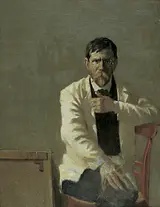
Johan Rohde: Self-portrait, 1890. The Hirschsprung Collection.
The Brotherhood of the Arts
In the 1890s, the writer Johannes Jørgensen founded the journal Taarnet, which became a focal point for the Symbolists and their leading advocates. The art historian Emil Hannover and artists Svend Hammershøi, Mogens Ballin, Ludvig Find and Albert Gottschalk contributed alongside poets such as Sophus Claussen and Sophus Michaëlis. Among the ideas expressed in Taarnet was that beauty and atmosphere should take precedence over line and colour.
This pursuit of beauty led to a widespread interest in design and the decorative arts. At The Hirschsprung Collection, visitors can see several examples of how Danish artists working across different media in the late 19th century helped broaden the understanding of what art could be. The collection includes woodcuts, embossed enamel badges, furniture and silverwork.
Taarnet drew considerable inspiration from French literary Symbolism and poets such as Charles Baudelaire, Arthur Rimbaud and Stéphane Mallarmé. Visual artists also looked towards France. In 1893, for example, Den Frie Exhibition presented 50 works by Paul Gauguin and 29 works by Vincent van Gogh.
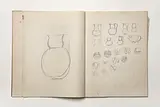
One of Johan Rohde’s sketchbooks. The Hirschsprung Collection.
Inspiration from Abroad
By the late 19th century, travelling through Europe had become increasingly accessible. Agnes and Harald Slott-Møller, for example, combined their honeymoon with a study trip to Italy, where they explored the religious art of the Early Renaissance. Artists such as Giotto (1267–1337), Cimabue (1240–1302) and Fra Angelico (1387–1455) became important sources of inspiration.
They shared this interest with the English Pre-Raphaelites and were also influenced by the British Arts and Crafts Movement (c. 1880–1910). Led by the art critic John Ruskin and the artist William Morris, the movement emerged partly in response to increasing industrialisation in Britain. Arts and Crafts artists emphasised skilled craftsmanship and believed that beautiful objects should be accessible to everyone. Art was to be integrated into everyday life.
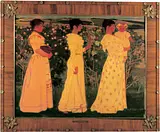
Harald Slott-Møller: Three women. Summer evening, 1895. The Hirschsprung Collection.
The later part of The Hirschsprung Collection takes visitors into the imaginative, sensuous and enigmatic world of the Symbolists. Look out, too, for works by other Symbolist artists in the collection, including L.A. Ring, Mogens Ballin and Ludvig Find.
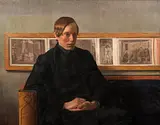
Ludvig Find: Portrait of the Norwegian painter Thorvald Erichsen, 1897. The Hirschsprung Collection.