The Funen Painters
An Artists’ Colony on Funen

Fritz Syberg: Spring, 1891-1893. The Hirschsprung Collection.
The Hirschsprung Collection holds several works by key figures associated with the Funen Painters. The collection includes drawings and paintings by Johannes Larsen, Fritz and Anna Syberg, Peter Hansen, Harald Holm, Karl Schou and Poul S. Christiansen, all of whom were part of the artists’ colony on Funen.
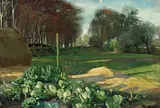
In his 1885 painting Woodland Scene. Autumn. Arreskov, Fritz Syberg focused on the fruits of the farmer’s labour: cabbages and haystacks.
Fritz Syberg: Woodland scene. Autumn. Arreskov, 1885. The Hirschsprung Collection.
Fritz Syberg: Woodland scene. Autumn. Arreskov, 1885. The Hirschsprung Collection.
Funen as a Meeting Place
The Funen Painters were a group of artists who, from the late 1880s until around 1920, gave the island of Funen a prominent place in Danish art. They formed a close-knit artistic community, connected by friendship and, in some cases, by family ties or marriage.
Almost all the Funen Painters were born, lived and worked on the island. They gathered around two main centres. One was Faaborg, where the manufacturer Mads Rasmussen financed Faaborg Museum and supported the Funen artists whose works were displayed there. The other was Kerteminde, where Johannes and Alhed Larsen and Fritz and Anna Syberg settled with their families.
Many artists were associated with the colony over the years. They shared an interest in painting outdoors and embraced the Impressionist aim of capturing an immediate impression of nature, with particular attention to changing light, weather and atmosphere. They also found their subjects close to home: everyday life, family life, rural communities and the surrounding landscape.
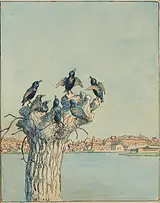
In 1925, Johannes Larsen painted this scene of a flock of starlings in an old willow tree, with the town of Kerteminde in the background. It was more than 20 years after he and his wife, the artist Alhed Larsen, had moved to Møllebakken in Kerteminde.
Photo: © Johannes Larsen/VISDA.
Watercolour was one of the Funen Painters’ preferred media. Fritz Syberg often drew and painted his wife, the artist Anna Syberg - the painter Peter Hansen’s sister - and their children. This interior from 1897 shows Anna and one of their daughters in the family home in Svanninge, before they moved to “Pilegården” near Kerteminde in 1902.
Meeting at the Artists’ Independent Study Schools
Most of the Funen Painters studied under Kristian Zahrtmann at the Artists’ Independent Study Schools in Copenhagen. It was here that several of them first met, laying the foundations for the lifelong friendships and artistic community that would later develop on Funen.
The Artists’ Independent Study Schools were founded in 1882 as an alternative to the traditional education offered by the Royal Danish Academy of Fine Arts. Zahrtmann began teaching there in 1885 and soon became so popular that the school was commonly known as “Zahrtmann’s School”.
He encouraged the young painters to experiment with bold colours and striking contrasts, while placing great emphasis on developing their own individual styles. Among Zahrtmann’s first students were the Funen Painters Johannes Larsen, Peter Hansen and Fritz Syberg.
After completing his studies under Zahrtmann, Fritz Syberg began work on one of his early masterpieces, Spring (1891–93), depicting an old farmhouse garden in Svanninge. The farmer stands at the centre of the painting. His white clothes and upright posture reflect the virtues Syberg associated with rural life: strength, diligence and purity.
The Peasant Painters Controversy
The Funen Painters’ sketch-like brushwork, bold simplification and strong colours often met with disapproval from critics early in their careers. Above all, however, it was their choice of ordinary subjects—pigsties, “insignificant impressions of nature” and scenes from private and domestic life—that provoked criticism and sparked fierce debates in the newspapers.
Critics referred to the Funen artists disparagingly as the “Peasant Painters”, but the artists themselves embraced the name and turned it into a badge of honour.
In 1907, a heated debate broke out in the newspaper Politiken. It later became known as the “Peasant Painters Debate”. On one side were the Symbolist painters Gudmund Hentze and the artist couple Agnes and Harald Slott-Møller, who represented a more intellectual, metropolitan culture. On the other were the art historian Karl Madsen and the Funen painter Peter Hansen, who defended the artists from the provinces.
The debate ended in favour of the “Peasant Painters”. It strengthened the group’s position in the Danish art world, while Hentze and the artists he spoke for became more marginalised within the official art establishment.
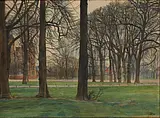
Peter Hansen skildrede ikke kun naturen på Fyn. Gennem sit liv vendte han jævnligt tilbage til København. Her ser vi et motiv fra Rosenborg Have udført i 1898.
Nature at the Centre
Nature was one of the Funen Painters’ main subjects, explored both indoors and out. Johannes Larsen was particularly fascinated by birds and often depicted them in his work. Using ink, watercolour or oil paint, he created precise and anatomically accurate studies of the birdlife around Kerteminde.
Anna Syberg approached the plants in her home with the same attention to detail. After marrying Fritz Syberg, she mainly painted watercolours of carefully observed floral arrangements in their home. The compositions varied, but she consistently chose modest houseplants as her subjects. She would often begin by drawing the motif in pencil, then add watercolour before finishing the work with outlines in black ink.
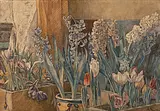
Krokus, hyacinter og tulipaner udgør næsten hele billedfladen i Anna Sybergs akvarel ’Forårsblomster’ fra 1898. Samme år erhvervede Henrich Hirschsprung værket, efter det havde været udstillet på Charlottenborgs Forårsudstilling.