Bertha Wegmann
A Danish Artist of International Renown
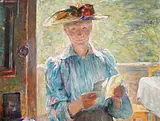
Bertha Wegmann: Portrait of the Swedish Pianist Hanna Lucia Bauck. Undated. The Hirschsprung Collection.
For a number of years, The Hirschsprung Collection has worked to strengthen the representation of Bertha Wegmann’s (1847–1926) work at the museum. Today, the collection includes eight paintings and one drawing by the artist, as well as several of her letters.
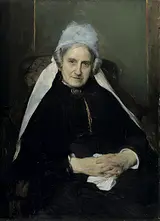
In 1888, Bertha Wegmann painted a portrait of the ageing Petrea Hirschsprung, mother of one of the museum’s founders, Heinrich Hirschsprung.
One of Denmark’s Leading Portrait Painters
Bertha Wegmann was a successful artist both in Denmark and abroad and was particularly sought after as a portrait painter. Over the years, she received numerous commissions from prominent members of society and well-known public figures, while her closest friends and family members also appeared in her paintings.
During her lifetime, Wegmann was widely praised for the sensitivity and authenticity with which she portrayed her sitters. She described her approach in the following words:
During her lifetime, Wegmann was widely praised for the sensitivity and authenticity with which she portrayed her sitters. She described her approach in the following words:
I always try to make my sitters forget themselves, so that their pose does not become self-conscious. I talk to them about someone they love or care about, and then they forget all the ideas they have formed about themselves. That is when they become real people.
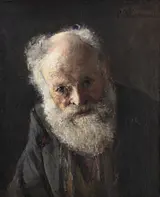
In this undated portrait, the elderly man looks out at us, his lips slightly parted. As in many of Wegmann’s portraits, there is a palpable sense of connection between sitter and artist.
In 1888, Wegmann came into contact with the Hirschsprung family when she painted a compelling portrait of Heinrich Hirschsprung’s mother, Petrea Hirschsprung. Seated in an armchair with her hands folded, she looks directly at us. The painting was presented to Pauline and Heinrich Hirschsprung as a gift on the occasion of their silver wedding anniversary on 26 June 1889.
Like many other artists of the period, Bertha Wegmann formed a close connection with Heinrich and Pauline Hirschsprung. Heinrich reportedly wanted Wegmann to paint Pauline’s portrait, although, as far as we know, the plan never came to fruition. In a letter to the painter Niels Pedersen Mols in the spring of 1891, Pauline wrote:
Do you know Miss Wegmann? You would benefit from spending time with her—she is so spirited. Give her our regards. My husband is always saying that she should paint me! Poor woman.
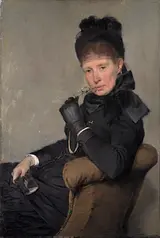
In this 1885 portrait, Wegmann depicted her close friend, the Swedish artist Jeanna Bauck. The two artists had met in Munich, where they had both travelled to study in the 1860s. They shared an apartment there for many years and remained in contact after returning to Denmark and Sweden respectively.
Women’s Access to Artistic Education
Throughout much of her life, Bertha Wegmann worked actively to improve women’s access to artistic education, while her own career helped pave the way for future generations.
After receiving the Thorvaldsen Medal at Charlottenborg in 1883, she became the first woman ever elected to the Plenary Assembly of the Royal Danish Academy of Fine Arts. Wegmann exhibited regularly at both Charlottenborg in Copenhagen and the Paris Salon. She also took part in numerous major official exhibitions across Scandinavia and Europe, including the world exhibitions in Paris in 1889 and 1900 and Chicago in 1893, as well as the landmark Women’s Exhibition of 1895. In 1892, she was also among the first women to receive the Danish Medal of Merit in gold.
Wegmann played an active role in several women’s organisations and networks of the period. From 1887 to 1907, she served on the board of the School of Drawing and Applied Art for Women. Like several other women artists of her generation, she chose a professional and domestic partnership over marriage, sharing her life and work with the German Toni Müller, whom she met in Munich in the early 1890s.
During the final decade of Wegmann’s life, they lived at the so-called Ladies’ Hotel at Gammel Mønt 1 in Copenhagen. The residence formed part of the Women Readers’ Association building, which housed not only a library and lecture hall, but also flats and rooms available to women active in cultural life.
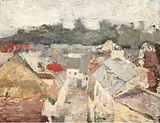
Wegmann’s work spans a wide range of subjects, from portraits and genre scenes to flower paintings and landscapes. In this small, undated oil painting, she has captured a view of an unidentified mountain village in broad, vigorous brushstrokes.
An Outsider in Danish Art
Bertha Wegmann was born in Switzerland but raised in Denmark, where her parents settled in 1852. In 1867, at the age of 20, she left Copenhagen for Munich to train as an artist and remained there until 1881. Throughout her long stay abroad, she maintained close ties with Denmark, and in 1883 she became a Danish citizen.
Like many of her contemporaries, Wegmann was drawn to modern French art, and from 1881 onwards she frequently spent time in Paris, then one of Europe’s leading artistic centres. For a period, she studied under the French painter Léon Bonnat and is also said to have visited Édouard Manet in his studio.
Her extensive training in Germany and her many stays in France enabled Wegmann to master the techniques, colours and subjects associated with the leading international Salon art of the period.
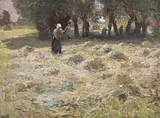
The painting of a woman turning hay is vivid and sharply defined. It is a study for a larger painting from 1888 depicting Écouen, north of Paris.
Bertha Wegmann has been described as an outsider in Danish art. Her absence from accounts of the pioneering artists of her generation is undoubtedly linked to the fact that she belonged to the international artistic currents of the period. In 1926, the Danish sculptor Rikard Magnussen commented on Wegmann’s international connections:
Bertha Wegmann’s development was shaped from an early stage by the art and artistic training she encountered abroad. When, after many years away, she settled permanently in Denmark in 1882, she returned as an artist of European renown, whose name commanded respect and whose paintings fetched prices rarely paid at the time for works by Danish artists.
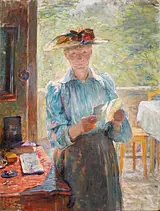
Wegmann’s portrait of the Swedish pianist Hanna Lucia Bauck is unlike anything else in Danish art. The technique, with unmixed colours applied side by side on the canvas, recalls the work of the French Impressionists.